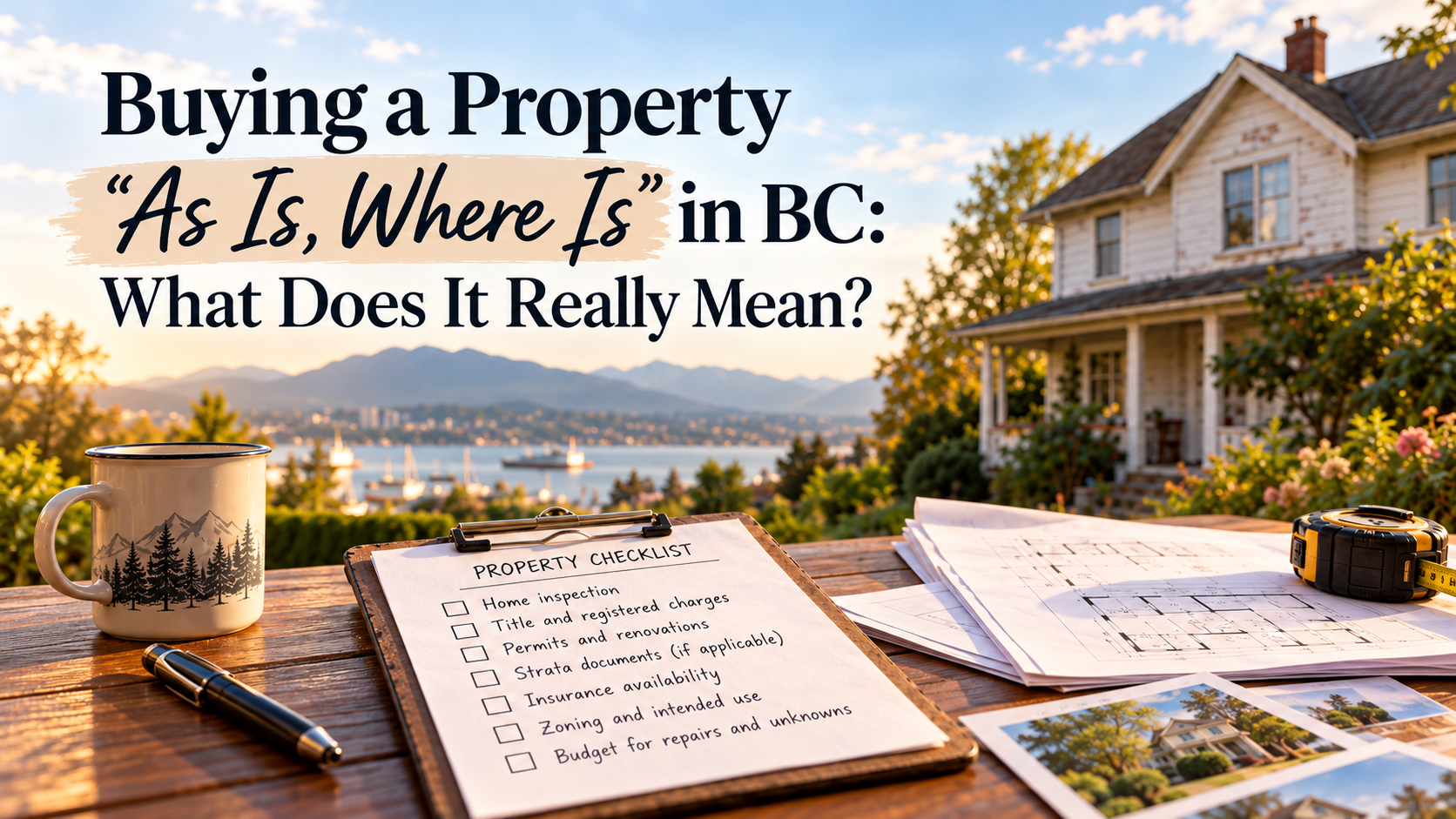
Every once in a while, you’ll come across a property being sold “as is, where is.” For some buyers, those words immediately raise a red flag. They can sound like the seller is essentially saying, “There could be all kinds of problems here, and once you buy it, they’re yours.”
Sometimes there is more uncertainty involved in an “as is” purchase, but the wording doesn’t automatically mean there’s something seriously wrong with the property or that it should be avoided. You’ll see this language used with estate sales, court-ordered sales, properties requiring substantial renovation and other situations where the seller may have limited knowledge about the home or may not be prepared to make the representations and warranties you would normally expect in a more conventional sale.
What the phrase should do is change the way you approach the property. If the seller is providing less information or fewer assurances about its condition, you need to become more deliberate about investigating what you can, understanding what you can’t, and deciding whether the price appropriately reflects that uncertainty.
What does “as is, where is” actually mean?
The exact meaning will always depend on the wording in the contract, but generally the seller is saying that the buyer is purchasing the property in its existing condition and that the seller is limiting the representations or warranties they’re prepared to provide about it. BCFSA even publishes sample “as-is, where-is” contract wording that is quite broad, covering matters such as condition, title, zoning, use and municipal compliance. That’s one reason I would never treat the phrase as casual boilerplate and assume every “as is” transaction is exactly the same.
There can also be perfectly understandable reasons for a seller taking this position. Imagine an executor selling a home that belonged to an elderly parent. The executor may never have lived there and may genuinely have no idea when the roof was replaced, why a particular area of drywall was repaired, whether the downstairs refrigerator works properly or exactly what renovations were completed 20 years ago. A lender involved in a court-ordered sale is in an even more obvious position: the lender didn’t live in the house and may know very little about its history.
Compare that with someone who has owned and occupied a home for 25 years. They may be able to tell you when the furnace was installed, who renovated the kitchen, whether the basement has ever leaked and why a section of the deck was replaced. The fact that an estate or lender can’t provide the same information doesn’t necessarily mean their property is worse. It simply means there may be fewer answers available to you, and when there are fewer answers coming from the seller, your own investigation becomes considerably more important.
“As is” doesn’t mean there’s no point inspecting the property
One misconception I sometimes hear is that there’s no point conducting a home inspection on an “as is” property because the seller isn’t going to repair anything anyway. I would actually look at it almost the opposite way. If you’re being asked to accept more responsibility for the condition of the property, understanding that condition becomes even more valuable.
What may change is the purpose of the inspection. In a conventional purchase, an inspection might uncover an issue that leads to a discussion with the seller about having something repaired, obtaining additional information or possibly renegotiating some aspect of the transaction. With an “as is” sale, the seller may simply have no interest in doing repairs. In that situation, the inspection may be less about creating a repair list for the seller and more about helping you understand the financial commitment you’re considering.
For example, suppose you’re looking at a home and the inspection indicates that the roof is approaching the end of its useful life, the furnace is 22 years old and the deck will likely need significant repairs in the next few years. Perhaps the seller’s position remains that the property is being sold exactly as it sits and they aren’t going to fix any of those things. The inspection has still provided you with extremely useful information. You can start putting realistic numbers beside those items, decide whether you’ll have enough money available after completing the purchase, and determine whether the price you’re paying makes sense given the work that may be ahead.
That’s a very different approach from simply hoping everything is fine because the seller isn’t prepared to make any promises about it.
The investigation can go well beyond the home inspection
A home inspection is important, but depending on the property, it may only answer part of the question. I may also want to understand what’s registered on title, whether renovations were properly permitted, how the property is zoned, whether insurance is readily available, and whether there are any issues that could affect the way a buyer intends to use the property. If it’s a strata property, then the strata documents, finances, insurance, depreciation report and meeting minutes become part of the investigation as well.
An older home with a basement suite is a good example. The suite may look perfectly functional and perhaps it has even been rented for many years. If rental income is important to the buyer’s plans, though, I’d want to investigate whether there are permits available for the work, how the property is zoned and whether there are other issues that could affect the continued use of that space. An inspector can tell you a great deal about the physical condition of the suite, but they aren’t necessarily going to tell you whether the municipality ever approved its construction.
You could encounter a similar issue with a heavily renovated home being sold by an estate. The kitchen may look great, walls may have been removed and an addition may have been built at some point, but if the executor has very little information about when or how that work was completed, I’d want to see what municipal records are available. Sometimes the most important question isn’t “Does the renovation look good?” but rather “What do we actually know about how this was done?”
A lower price doesn’t automatically mean you’re getting a bargain
This is where I think buyers need to be particularly careful with “as is” properties. A lower asking price can make a property feel like an opportunity before you’ve really worked through what that discount is compensating you for.
Imagine two reasonably comparable homes in the same neighbourhood. One is in good condition and would probably sell for around $1.1 million. The second is offered “as is” for $999,000. At first glance, the second property appears to offer roughly $100,000 in savings, and that can be very appealing.
Now imagine that your investigation suggests the $999,000 home will probably need a $25,000 roof relatively soon, $15,000 of drainage work, a new furnace and a meaningful amount of interior renovation. There’s also an older addition on the back of the house and you haven’t been able to determine exactly when it was constructed or what permits were obtained.
That doesn’t suddenly make the house a bad purchase. Maybe you were planning to renovate anyway. Perhaps you can perform some of the work yourself, the lot is superior, or the location is better than the $1.1 million property. You may still decide that it represents excellent value. But you’re no longer comparing a $999,000 house directly with a $1.1 million house. You’re comparing two properties with very different costs, conditions and levels of uncertainty.
That’s why I wouldn’t confuse a discounted price with a bargain. The discount needs to make sense relative to the repairs you already know about and the uncertainty you’re agreeing to take on.
Does “as is” mean the seller can hide problems?
This is an area where buyers and sellers both need to be careful about making broad assumptions. An “as is, where is” clause can significantly limit the representations and warranties being made by a seller, but the words should not simply be interpreted to mean that every disclosure obligation disappears.
B.C. law distinguishes between defects that a buyer can reasonably discover and certain hidden, or latent, defects. There are obligations relating to known material latent defects, and B.C. real estate professionals have their own disclosure responsibilities. BCFSA’s guidance specifically notes that real estate professionals cannot contract out of their obligation to disclose known material latent defects simply because a transaction contains “as is” wording.
The difficulty is that real-world disputes are rarely as simple as asking whether the words “as is” appeared in the contract. What did the seller actually know? What did the buyer ask? What representations were made? Was the problem something a reasonable inspection could have revealed? What does the specific contract say?
If a serious issue arises after completion, those can become legal questions and I wouldn’t attempt to answer them simply by pointing to three words in a listing. From a buyer’s perspective, I would much rather do as much investigation as reasonably possible before purchasing than buy a property on the assumption that a lawyer will sort things out afterward if something goes wrong.
What if the seller can’t provide much information about the property?
This comes up frequently with estates and similar transactions. You may receive limited disclosure because the person handling the sale simply doesn’t know very much about the history of the home. Again, I wouldn’t automatically interpret that as evidence that there is a hidden problem. Sometimes the seller genuinely doesn’t know.
The practical consequence is that we need to look elsewhere for information. Depending on the situation, that might involve a professional home inspection, municipal permit records, title documents, a contractor’s opinion, insurance inquiries or strata documents. It can also mean asking more targeted questions about anything we notice while viewing the property.
There may still be questions we simply cannot answer with certainty, and that’s an important part of the decision too. Due diligence doesn’t always produce a perfect folder containing every answer about a property. Sometimes its purpose is to help us identify what remains unknown so that you can decide whether you’re comfortable accepting that uncertainty.
I would also involve the buyer’s mortgage professional and insurance provider early if there are significant concerns about the property’s condition. A home that needs extensive work may create financing or insurance considerations that are better discovered before you become committed to the transaction rather than a few days before completion.
Court-ordered sales are a good example of why this wording exists
Court-ordered sales are probably one of the situations where buyers most commonly encounter “as is, where is” wording. In a foreclosure proceeding, a lender may be granted conduct of sale by the court, but that lender hasn’t lived in the house and generally isn’t in a position to provide the same information or assurances that an owner-occupier might provide.
These transactions also have a different process from an ordinary resale. BCREA notes that properties sold under court order are typically sold “as-is, where-is,” the sale requires court approval, and competing offers can sometimes arise as part of the court process. Once the court approves the sale, the Home Buyer Rescission Period does not apply.
That doesn’t mean court-ordered sales should automatically be avoided. It means buyers should understand that the process and the information available to them may be different. I’d particularly want a buyer to understand those differences before becoming emotionally or financially committed to the idea that they’ve found an unusually inexpensive property.
Not every “as is” property carries the same amount of risk
This may be one of the most important points in the entire discussion. The phrase itself doesn’t tell you how much risk you’re actually taking on.
Imagine three properties that are all being sold “as is.” The first is a 20-year-old condo being sold by an estate. The executor can’t tell you much about the individual unit, but we have extensive strata records, recent financial statements, a depreciation report, years of meeting minutes and a professional inspection of the condo itself.
The second is a 1960s detached house that has been owned by the same person for 40 years. There have been several additions and renovations over the decades, but very little documentation is available and nobody involved with the estate knows exactly when the work was done.
The third is a badly deteriorated house being marketed primarily for its land value, where everyone involved understands that substantial redevelopment or reconstruction is likely.
All three could contain virtually identical “as is” wording, yet the nature of the uncertainty is completely different. With the condo, we may actually have an enormous amount of information despite the seller’s limited personal knowledge. With the 1960s house, we might have considerably more uncertainty around renovations, building systems and permits. With the third property, the current condition of the house may not even be central to the buyer’s plans.
That’s why I wouldn’t decide whether to pursue a property based solely on seeing “as is” in the listing. I’d want to understand what is unknown and whether those unknowns actually matter to the way you intend to use the property.
Leave some room in your budget for surprises
Another consideration is how much financial flexibility you’ll have after the purchase. If a property comes with genuine uncertainty, using every available dollar for the down payment and leaving yourself with no reserve for repairs can put you in a difficult position.
Suppose your inspection and research identify approximately $40,000 of work you expect to complete over the first couple of years. I wouldn’t necessarily assume the final number will be exactly $40,000. Anyone who has undertaken a significant renovation knows that once walls are opened or contractors start looking more closely at older systems, additional work can sometimes appear.
That doesn’t mean budgeting as though everything will go wrong. It simply means leaving some room for things you couldn’t reasonably identify beforehand. The older and more complicated the property is, the more important that financial cushion can become.
The same property may therefore make perfect sense for one buyer and very little sense for another. A contractor with renovation experience, access to trades and substantial cash reserves may be very comfortable taking on a property with some unknowns. A first-time buyer who has used nearly all of their available savings for the down payment may reasonably look at exactly the same house and decide that the uncertainty isn’t worth it.
Neither buyer is necessarily right or wrong. They simply have different abilities to absorb the risk.
So, should you avoid an “as is, where is” property?
Not automatically. Some “as is” properties can present excellent opportunities. They may offer renovation potential, redevelopment possibilities, a desirable lot or location, or simply less competition because other buyers are uncomfortable with the additional uncertainty.
What matters is understanding why the property is being sold that way, investigating as much as reasonably possible and making sure the numbers still work once you factor in the condition of the property and the things you don’t know.
For me, that’s really the distinction. I wouldn’t look at an “as is” property and ask only, “Is this risky?” Every real estate purchase carries some degree of risk. I’d rather ask: What specifically is the risk here? What can we investigate? What will it cost to deal with the things we already know about? What remains uncertain? And is the price attractive enough to compensate you for taking that on?
Those questions give you something much more useful to work with than the words “as is” by themselves.
Final thoughts
The words “as is, where is” shouldn’t automatically scare you away from a property, but they should make you slow down and understand exactly what you’re being asked to purchase. Ask more questions, inspect what can be inspected, investigate the property’s history where appropriate, understand the contract and make sure you have room in your budget for the work and uncertainty that may come with it.
Depending on the property, that could mean involving a home inspector, contractor, lawyer, insurance broker, mortgage professional or another appropriate expert. It may also mean accepting that, even after completing reasonable due diligence, there are some questions nobody can answer with certainty.
The goal isn’t to eliminate every possible risk before buying a home. That isn’t realistic. The goal is to understand what you know, what you don’t know, what you can reasonably find out and whether the price makes sense given the risk you’re agreeing to take on.
Sometimes an “as is” property can be a very good opportunity. But the opportunity doesn’t come simply from seeing a lower asking price. It comes from understanding the property well enough to decide whether that price represents good value for you.
This article is intended to provide general real estate information and is not legal advice. The effect of specific contract wording and disclosure obligations can depend on the circumstances of an individual transaction.
Jeremy Kyle, MBA
RE/MAX All Points Realty
www.kylerealestate.ca

 The data relating to real estate on this website comes in part from the MLS® Reciprocity program of either the Greater Vancouver REALTORS® (GVR), the Fraser Valley Real Estate Board (FVREB) or the Chilliwack and District Real Estate Board (CADREB). Real estate listings held by participating real estate firms are marked with the MLS® logo and detailed information about the listing includes the name of the listing agent. This representation is based in whole or part on data generated by either the GVR, the FVREB or the CADREB which assumes no responsibility for its accuracy. The materials contained on this page may not be reproduced without the express written consent of either the GVR, the FVREB or the CADREB.