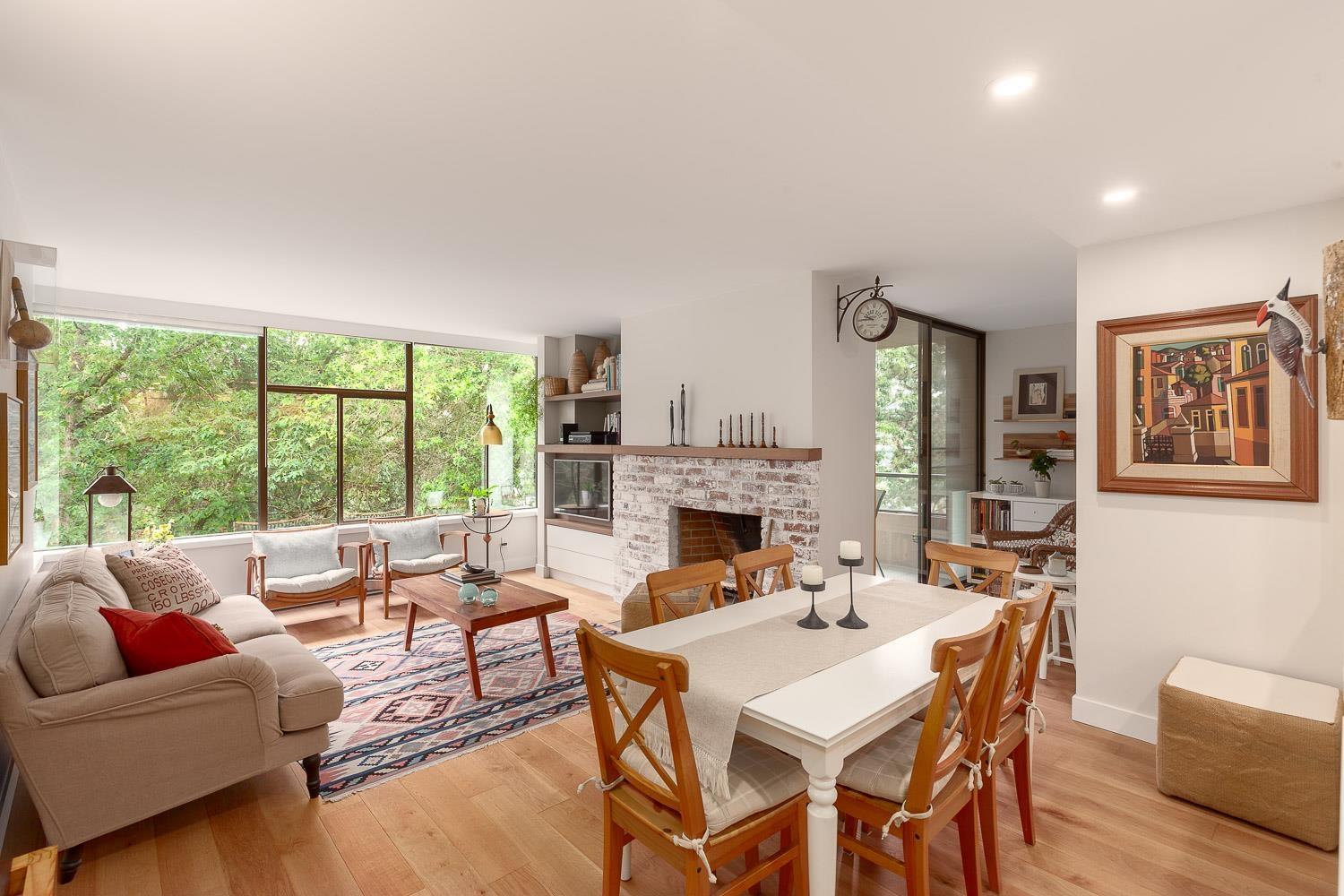
Older condos can offer larger floor plans, better locations and more space for your money. But before buying one, it's important to understand what you're getting into.
When shopping for a condo, it's easy to focus on newer developments with modern finishes and the latest amenities. However, some of the best opportunities can be found in older buildings, particularly if you're looking for more space, a practical floor plan or an established neighbourhood.
Older condos often have features that are becoming harder to find in newer developments. Larger bedrooms, separate dining rooms, generous living spaces, plenty of storage and, in some cases, significantly more square footage for your money. You may also find buildings in established neighbourhoods with mature landscaping, convenient access to amenities and locations where new construction is limited.
Of course, buying an older condo also comes with considerations that extend well beyond the individual unit. When you purchase a strata property, you're also taking on a share of the building's maintenance responsibilities, financial obligations and future expenses. That's why understanding the condition of the building and how it's been managed over the years is so important.
Here are some of the things I recommend looking into when considering an older condo in British Columbia.
1. Look beyond the age of the building
Two condo buildings constructed in the same year can have remarkably different maintenance histories. One might have recently completed a major roofing project, replaced its plumbing and upgraded its elevators, while another could still have all three of those expenses ahead of it. Despite being the same age, their anticipated maintenance costs and the financial obligations facing their owners could be quite different.
I always encourage buyers to investigate what's already been replaced, what still needs attention and whether the strata has been proactive about maintaining its property. Major components such as the roof, building envelope, plumbing, windows, balconies, elevators and underground parking membranes can all involve substantial expenditures. You don't necessarily need to find a building where everything has already been replaced, but you should understand the condition of these components and what expenses could be coming.
For example, imagine you're considering two condos. One has a beautiful $75,000 interior renovation, complete with a new kitchen, bathrooms and flooring, but the building has aging plumbing and is approaching a major building-envelope project. The other has a dated interior that could use some cosmetic improvements, but the building has recently completed several major capital projects. Neither is automatically the better purchase, but the second might give you more control over when and how you spend money on improvements. With the first, you could be facing substantial building expenses that are largely outside your control.
2. Read the depreciation report and understand what it tells you
One of the most valuable documents when evaluating an older strata property is its depreciation report. This report assesses major building components, estimates their remaining useful lives and projects the costs of maintaining, repairing or replacing them over a 30-year period. In B.C., strata corporations with five or more strata lots are generally required to obtain a depreciation report every five years.
I wouldn't automatically be concerned about a depreciation report identifying substantial upcoming expenses. Every building eventually needs repairs, and older buildings will naturally have components approaching the end of their expected lifespans. What matters is whether the strata understands those expenses and has been planning for them. A building anticipating a $2 million roof replacement in five years might already have substantial funds set aside or an established financing strategy. Another building might have the same anticipated expense but little money saved and no clear indication of how the owners intend to pay for it.
It's also important to remember that depreciation reports are planning documents, not guarantees. Projected costs can change, components can deteriorate more quickly than expected and unforeseen repairs can arise. When reviewing a report, I like to compare its recommendations with the strata meeting minutes and financial statements to see whether the building has actually been following through on its maintenance plans.
3. A large contingency reserve fund doesn't always mean a financially healthy building
One of the first questions buyers often ask is how much money the strata has in its contingency reserve fund (CRF). This is money set aside to help pay for expenses that occur less frequently than regular operating costs, such as replacing a roof, upgrading an elevator or undertaking major building repairs. Having a substantial reserve is certainly encouraging, but the balance alone doesn't tell you nearly enough about the building's financial position.
Consider the following two hypothetical buildings.
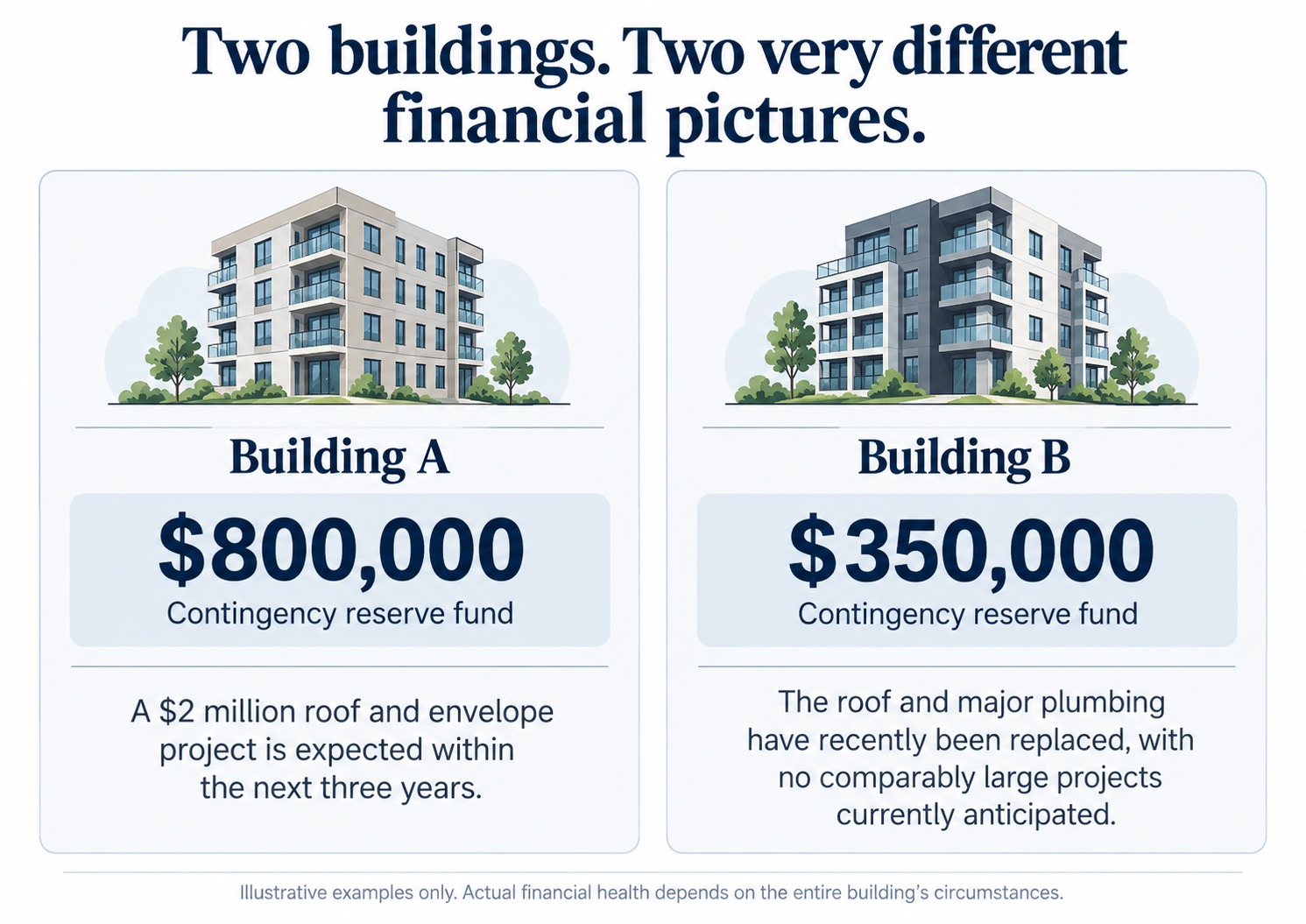
At first glance, Building A might appear to be in a stronger financial position because it has considerably more money available. However, once you account for its upcoming expenses, the picture changes. Building B may be in a more comfortable position because it has already completed some of its largest projects. Of course, we'd still need to examine the age and condition of its remaining components, future maintenance requirements and how much money the strata contributes to its reserve fund each year.
This is why I prefer to look at the contingency fund alongside the depreciation report, operating budget, financial statements and history of special levies. The amount of money a strata has saved is important, but understanding what it will need that money for is equally important.
4. The strata minutes can tell you a lot about how a building is managed
Strata meeting minutes are among the most revealing documents available to buyers. While financial statements show where money is being spent, meeting minutes can provide insight into how the strata identifies problems, makes decisions and manages ongoing maintenance. I recommend reviewing the available council meeting minutes along with the annual general meeting (AGM) and any special general meeting (SGM) minutes.
As you read through them, pay attention to recurring issues rather than focusing on every individual complaint or repair. For example, a mention of a leaking pipe in one meeting wouldn't necessarily concern me. However, if water leaks have been discussed repeatedly over the past two years, several insurance claims have been made and the council has been considering a complete plumbing replacement, that's something worth investigating further. Similarly, repeated discussions about a major project that owners continually vote against could indicate that necessary maintenance is being postponed.
The goal isn't to find a building with no problems. Every strata will encounter maintenance issues, particularly as its building ages. What I want to see is evidence that problems are being investigated, qualified professionals are being consulted and the strata is taking appropriate steps to address them. A building with a history of identifying and completing necessary work can present a very different picture from one that has been postponing difficult decisions for years.
5. Don't be fooled by low strata fees
Low monthly strata fees can look attractive when comparing properties, but they don't necessarily mean a building is less expensive to own over the long term. Strata fees pay for regular operating expenses and contributions to the contingency reserve fund. Depending on the building, these expenses might include insurance, landscaping, cleaning, management, utilities, amenities and ongoing maintenance.
A building that has kept its strata fees unusually low for years might be operating efficiently, or it might be underfunding future repairs. Imagine two similar buildings where one charges $350 per month and the other charges $500. The less expensive building initially looks appealing, but if its owners have consistently voted to keep fees low rather than adequately funding the contingency reserve, they could eventually face substantial fee increases or special levies. Meanwhile, the building with higher monthly fees may have been steadily accumulating money for upcoming projects.
Rather than automatically favouring the building with the lowest fees, I look at what those fees cover, how much is being contributed to the contingency reserve fund and whether the strata has an appropriate plan for its anticipated expenses. A well-maintained building costs money to operate, and understanding where that money goes is an important part of evaluating a purchase.
6. Understand special levies and their potential impact on your budget
Special levies are another important consideration, particularly when purchasing into a building with major projects approaching. A special levy is an additional amount owners are required to contribute toward a specific expense. These are commonly used when a major repair or replacement project cannot be fully funded through the regular operating budget or contingency reserve fund.
For example, imagine a 100-unit building that approves a $2 million building-envelope project. If that expense were divided equally among all 100 units, each owner would be responsible for $20,000. In reality, special levies are generally allocated according to unit entitlement or another legally applicable method, meaning some owners may pay considerably more or less than others.
For a buyer who has just used most of their available savings for a down payment, an unexpected $20,000 expense could be financially challenging. That's why it's important to investigate whether major projects are being contemplated and whether any special levies have already been approved. B.C.'s Form B Information Certificate discloses approved special levies with future payment obligations, but it won't necessarily tell you about every expense the strata might consider in the future. Those potential expenses often become apparent when reviewing the depreciation report, meeting minutes and other available building information.
If a special levy has already been approved, make sure you understand the payment schedule and how responsibility for the payments is being addressed in your purchase contract. Your real estate lawyer or notary can help clarify the financial obligations associated with a particular purchase.
7. Review the building's insurance
Insurance is another area that deserves attention when evaluating an older condo. Review the building's current coverage, insurance history and deductibles, particularly those relating to water damage. Depending on the building's claims history and other risk factors, deductibles can be substantial, potentially exposing individual owners to significant expenses if they're found responsible for a loss.
For example, imagine a dishwasher supply line fails in your condo and causes water damage to several units below. Depending on the circumstances, the strata may be able to recover its insurance deductible from you, even if you weren't negligent. Some strata insurance deductibles can reach hundreds of thousands of dollars, making appropriate personal condo insurance particularly important.
Before removing your purchase conditions, I recommend speaking with an insurance broker to ensure you can obtain appropriate coverage for the property. Your personal insurance should be considered alongside the building's policy, including coverage for your belongings, improvements to the unit, personal liability and potential strata deductible assessments. Previous claims or significant increases in the building's insurance premiums are also worth investigating.
8. Don't forget to evaluate the individual condo
While much of the due diligence involved in buying an older condo focuses on the building, the condition of the individual unit still matters. An older condo might have original appliances, aging plumbing fixtures, dated electrical components or flooring and cabinetry that have reached the end of their useful lives. These issues aren't necessarily deal-breakers, particularly if the property is priced accordingly, but they should be considered when establishing your renovation budget.
If the unit has already been renovated, it's worth understanding what work was completed, whether permits or strata approval were required and whether those approvals were obtained. A newly renovated kitchen doesn't necessarily mean the plumbing or electrical systems behind the walls have been upgraded. I also recommend obtaining a professional home inspection, which can identify visible issues within the unit and highlight areas that warrant further investigation.
Finally, don't overlook the strata bylaws and other practical considerations. If you have pets, plan to rent out the property or hope to undertake renovations, make sure you understand the applicable rules. Confirm how parking spaces and storage lockers are allocated and whether any alterations or improvements you're planning would require strata approval.
Final thoughts: older doesn't mean worse
Some older condos can be excellent purchases, offering floor plans, room sizes and locations that may be difficult to find in newer developments at a comparable price. I've also seen older buildings that have been exceptionally well maintained, with proactive strata councils, substantial upgrades and sensible financial planning. Conversely, even relatively new buildings can encounter significant maintenance problems or unexpected expenses.
The important thing is to look at the complete picture. A dated interior might be relatively straightforward to improve, while major building repairs can involve substantial costs and decisions outside your control. Before purchasing, take the time to understand what's already been done, what's likely coming next and whether the strata appears financially prepared to handle those obligations.
Buying an older condo isn't about finding a building that will never need repairs. Every building will eventually require maintenance and the replacement of major components. The goal is to understand those responsibilities before you purchase, rather than discovering them after you've moved in.
If you're considering buying an older condo in Coquitlam, Port Coquitlam, Port Moody or the surrounding area, I'd be happy to help you evaluate your options and review the strata documents so you can make a well-informed decision.
Jeremy Kyle, MBA
RE/MAX All Points Realty



 The data relating to real estate on this website comes in part from the MLS® Reciprocity program of either the Greater Vancouver REALTORS® (GVR), the Fraser Valley Real Estate Board (FVREB) or the Chilliwack and District Real Estate Board (CADREB). Real estate listings held by participating real estate firms are marked with the MLS® logo and detailed information about the listing includes the name of the listing agent. This representation is based in whole or part on data generated by either the GVR, the FVREB or the CADREB which assumes no responsibility for its accuracy. The materials contained on this page may not be reproduced without the express written consent of either the GVR, the FVREB or the CADREB.